
As we become more sedentary both at work and at home, low back pain and sciatica become more common. Some people have very mild symptoms, such as their leg falling asleep or soreness when they first stand. While others have sciatica that has progressed to be very debilitating and have a hard time walking, standing, or even sitting in a chair for an extended time. While sciatica is becoming more common, it is very confusing and many people present very differently. This is due to there being several different causes of sciatica, which can drastically alter the presentation and symptoms.
Impingement on Sciatic Nerve
One of the more common causes of sciatica is an impingement on the sciatic nerve under the piriformis. The sciatic nerve is one of the biggest nerves in the body, and runs all the way from your lower spine down into the foot. This nerve passes right underneath a small muscle in the hip called the piriformis. This muscle is responsible for rotating the leg, and also helps with kicking the leg sideways.
When other muscles of the hip, such as the glute max, are weak or underused, the piriformis helps compensate for this and is used to partially extend the hip. This causes a significant amount of tension on the piriformis, and causes it to tighten. When this muscle gets too tight it can press in and “pinch” the sciatic nerve. When the nerve is pressed, you start to feel numbness, tingling, or even a burning sensation down the leg. Once we are able to correct the weakness in the hip, reduce tension on the piriformis, and improve overall mobility this pain is resolved.
Impingement at the Nerve Root
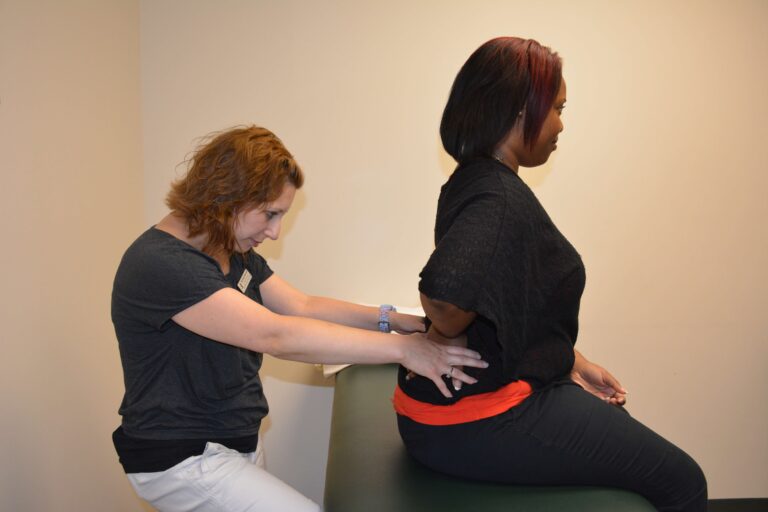
Another common cause of sciatica is an impingement at the nerve root. The sciatic nerve exits the spine between the L4 vertebrae to the S3 vertebrae., or the lower back by the belt line into the hip. When a nerve is impinged at the root, it is not usually by muscles but rather by the bones themselves. If this is the case people feel the pain starting all the way up into the back. They also often have trouble bending, lifting, and carrying things. When the problem is caused by an impingement at the spine you are usually able to feel significant relief with joint mobilizations. Clinicians will manually slide the vertebrae to make it glide more smoothly and increase the space in the joint. This paired with exercise help stabilize the joints in their spaced positions. It can also greatly reduce the amount of pressure on the nerve roots and provide significant relief for the patients.
While the two causes of sciatica are vastly different, both variations are able to get relief with physical therapy. During your initial evaluation your clinician will be able to tell you what the cause of your sciatica
is and create an individualized plan to get you moving pain free. If you, or somebody you know are suffering from sciatica give us a call at 703-450-4300 or CLICK HERE to get started!